
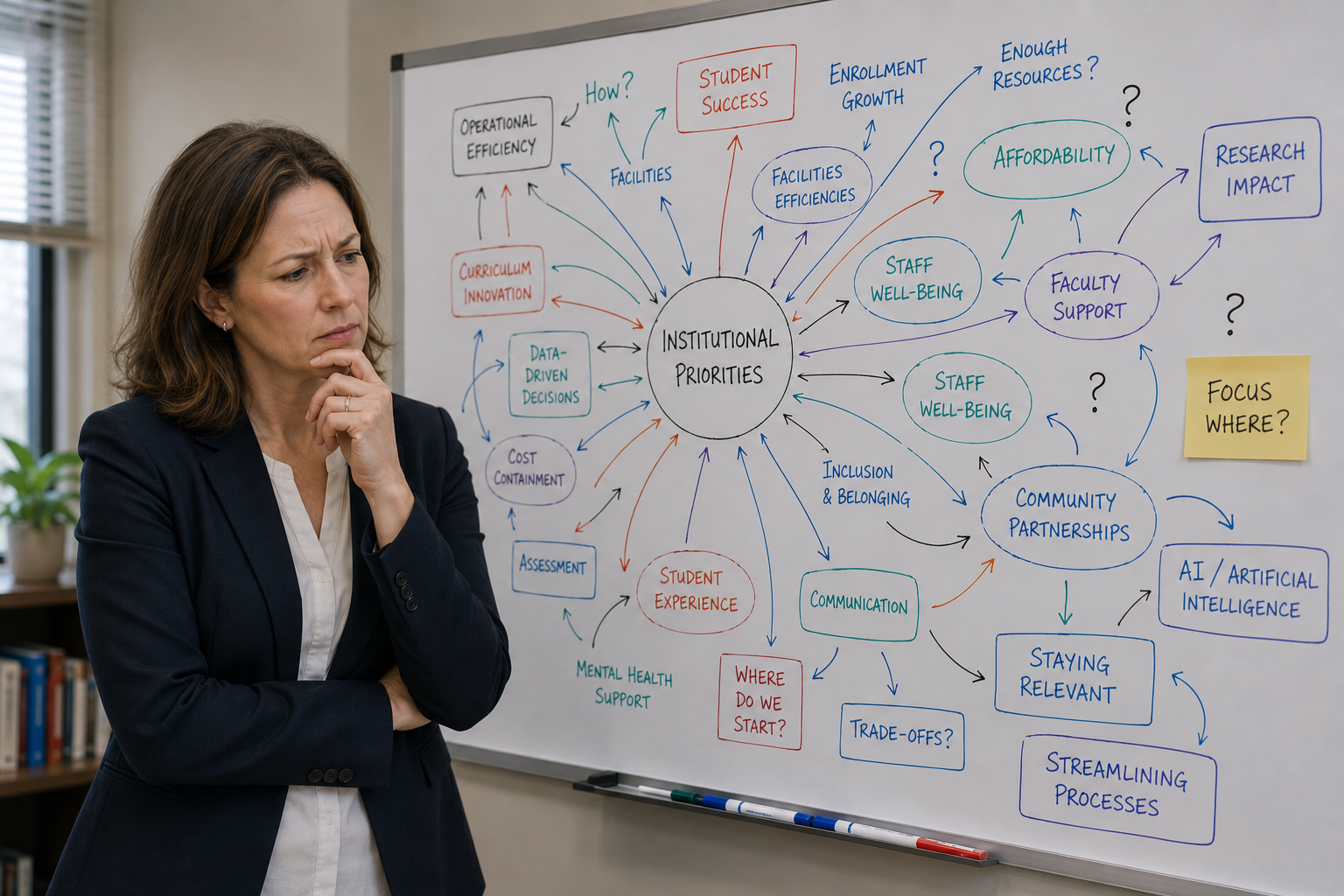
Priorities
Having too many priorities is the same as having no priorities at all. Yet, this is how most higher ed. leaders feel now. Everything is important and needs attention, most priorities are urgent, and there aren’t enough hours in a day, or enough employees in each department to handle everything. What to do then?
Always start with the end in mind
We tend to confuse strategies or activities with actual outcomes. It’s one of the reasons why it’s so difficult to stop doing something or de-prioritizing. Please make a list of the many priorities that you have, and for each, state what outcome you seek.
From there, you can create some clusters of priorities that lead to the same outcomes. Next, prioritize your outcomes. Solutions will start to emerge.
For example, if an important outcome is to eliminate waste and duplication of efforts, prioritize efforts to evaluate the return on investment of time and money. Higher education is too resistant to change and too attached to tradition, but these days are over.
Making visible progress
I encourage you to cluster priorities that lead to the same outcome because it will bring clarity and you will see progress more quickly. I wish I could provide an example perfectly suited to your position, but my readers are in academic services, student services, finance, administration, fundraising, etc. and there is no example that will be relevant to all.
So, I’ll take an example that most people can relate to, which is to tidy up your own home. If you walk into the kitchen, wash two dishes, leave the rest, get distracted, start a load of laundry, start organizing a closet, remove bed sheets to wash them, go get groceries, get back home, and keep moving from room to room, by the end of your day, the house will look worse than when you started. Scattered leadership can feel like that!
In your home, you will finish cleaning the kitchen before you move to a different room or go run errands. You will see progress and accomplishments. Try to think in similar ways when it comes to the department you lead. Which tasks or strategies will bring tangible progress to an important outcome? Obviously, you will have to work on several significant outcomes and can’t put everything on the back burner until each large outcome is created. But not being constantly pulled in different directions will make a noticeable difference and you will feel better.
Reduce, simplify, eliminate
One factor that leads to “too much to do and not enough time” is continuing to do things as they have always been done. But this is no longer possible. It’s time to look for new technologies that can streamline processes, implement time management best practices, and reflect on the ROI of each activity and meeting. Meetings need to be run effectively and lead to decisions, action steps, and accountability.
Highly resistant people who slow down progress, whether they have a valid argument or not, need to be reminded to dwell less on problems and focus more on solutions. The harsh truth is that institutions that are too slow to evolve may not be sustainable. Would you rather make some compromises or close your doors permanently?
Regarding academic programs, some are still in high demand (e.g., nursing), some need significant updates to be relevant to tomorrow’s workforce, and some should be retired entirely because by the time students graduate, there won’t be any jobs for them. I understand how difficult it is to change employee job descriptions, and how to handle faculty members who refuse to retool and evolve, to remain relevant in the classroom. Faculty contracts and bargaining units often focus on short-term resistance rather than long-term vision.
Allocation of resources
I bet the first thought that came to mind when you read “allocation of resources” was budget allocation. In addition to money, think of people as your most valuable resources. Give your innovative, entrepreneurial, and creative employees a chance to use their strengths and positive mindset to lead change.
Also, think of who are the employees and managers who are naturally friendly and charismatic, and who know how to present ideas in a positive light to get buy-in. If you’re not sure, you can use personality tests and strength assessments. But I would bet you already know who is a “Yes, I can” person and who is a “No, we can’t do that; it won’t work” person.
In summary, group priorities by common outcomes, prioritize outcomes, question old habits and processes, and delegate in a way that matches employees’ strengths and mindsets to the goals at hand. Make sure each important project has a lead who takes full ownership of everything that happens under their watch. You need people who you can rely on and stop trying to handle everything yourself.
Taking ownership
When in fear, the human mind tends to focus on “How is this going to affect me and what can I do to protect myself?”. While this makes sense from a survival standpoint, it is the opposite of what you want to foster in your department. A significant factor to your success is shifting employees’ attention from their own selves to the mission at hand.
Create a culture focused on a compelling vision, teamwork (as opposed to self-protection), positive reinforcement, and full ownership at every level of the organization. It’s important to clarify that taking ownership is not about blaming oneself but doing all that can be done to create better outcomes.
It is a turbulent and highly disruptive time in higher ed. It reminds me of what happens when someone is injured because a drunk driver hit them. Is it the injured people’s fault? No. Is it fair? Absolutely not. But who needs to take ownership of the steps required to heal? It’s the injured person who will have to endure medical procedures and months of physical therapy.
Saying: “I didn’t cause the problem therefore it’s not my responsibility to fix it” shows a concerning disconnect between reality and interpretation.
I know, this feels like a lot, because it is a lot. You shouldn’t have to do this alone. I invite you to click here to schedule a complimentary call with me and discuss how I can work with you during this most critical time. Athletes and top performers have coaches. If you are responsible, ambitious, and highly engaged, you deserve a coach too! Looking forward to meeting you.
About the author: Dr. Audrey Reille has empowered thousands of professionals through one-on-one coaching, group coaching, speaking engagements, and online courses. Audrey is the go-to executive coach for leaders in higher education administration. She empowers them to thrive by improving communication, confidence, executive presence, effectiveness, reducing stress, optimizing strategies, improving professional relationships, and developing a strong and empowered mindset.