
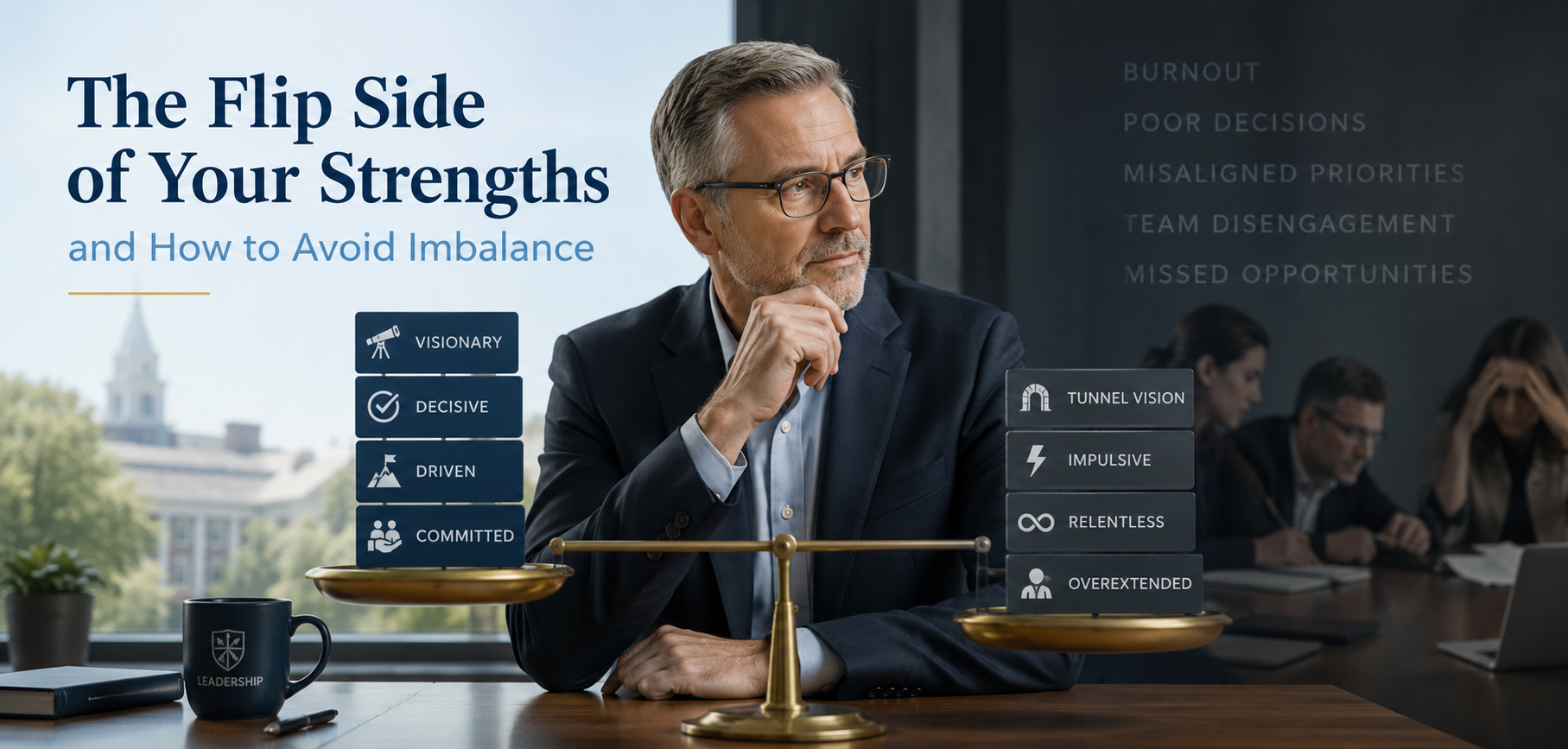
Everything in moderation
What praise do you often receive? What beliefs, values, and behaviors make you proud? Few higher ed. leaders have a high level of self-awareness, but all have values and strengths they demonstrate intentionally. It’s often because a former supervisor or coworker was a role model. Or the opposite, when someone’s behavior was unacceptable, people saw what they never wanted to become.
One thing I find particularly interesting as an executive coach is how often a client wants to be perceived in a certain way, but they already are, and nobody is questioning it! They have already proven themselves. Still, there is too much focus on what they value and not enough on their blind spots. Let me give you some examples of qualities that, when expressed excessively, create problems.
1. Collaborative leader
Higher ed. leadership requires collaboration, willingness to listen to different points of view, and respect for shared governance. Can you succeed if you refuse to be collaborative? Probably not, or you may last a year or two before a vote of no confidence or a Board’s decision leads you to retire early.
The many downsides of being overly collaborative include spending too much time in unproductive meetings, inviting too much complaining and resistance from others, trying to please everyone, struggling to make controversial decisions, feeling too much self-doubt and being indecisive.
2. Result-driven leader
Personally, I value outcomes more than how much effort went into a project. If someone takes six months to complete something mediocre and someone else can do it better and faster, I’ll choose the better and faster option. When I worked in higher ed., every time we created a committee for something that could be done in a day, I thought taxpayers’ dollars were not spent wisely. I like the concept of merit pay over the concept of longevity pay-increase or over-time for slower workers. I value outcomes more than misguided sacrifices!
That being said, leaders who rush to the finish line tend to overlook important factors, fail to consult with stakeholders, risk damaging professional relationships, and make costly mistakes. Some might even look like bulldozers if they are too dismissive or don’t respect other managers’ authority and decision-making power. I see huge mistakes made in re-organizations, or changes in priorities when leaders are too aggressive in their approach.
3. Confident leader
Leaders must be confident and make their teams feel that they are in good hands. Managers who are full of self-doubt are contagious! How is anyone supposed to follow a leader who isn’t sure where they are going? One of the most powerful leadership traits is for someone to show that they are steady, not easily frazzled or manipulated, and can handle anything that life throws at them.
The downside is that some leaders are excessively confident and optimistic. They may have a compelling vision of success that is simply not attainable and refuse to listen to anyone who brings valuable input. They are at risk of under-preparing and overlooking critical information because they rely too much on their optimism and charisma. They are likely to ignore policies that are inconvenient, and cause liability. And of course, some seemingly confident leaders may appear arrogant, dismissive, hard to relate to, or off-putting.
4. Cautious leader
In higher education, we don’t seek leaders who may go rogue and choose so much disruption that employee morale tanks. We want people in charge of making important decisions to think things through and reflect on how their decisions will affect stakeholders.
The downside is the risk of analysis paralysis, being unable to simplify complicated matters and being frozen when no course of action guarantees success at every level. We’ve all met at least one manager who shuts down every idea for fear that something might go wrong, or because they remember a similar past event that didn’t turn out well. Higher ed. is complex. Leaders need the ability to simplify how they look at problems, see the bottom line, prioritize, and act. That’s why the best leaders have coaches to act as sounding boards and ask skillful questions to get them unstuck and optimize outcomes.
Bottom line
I could go on and on for many pages, but you get the point. Qualities in excess carry negative sides. That is why leaders need someone to ask the hard questions, help them think new thoughts, expand their perspectives, and use their strengths without excess.
For all these reasons, I encourage you to click here to schedule a complimentary call with me. I want to hear about your job, responsibilities, circumstances, goals and challenges. Then we will discuss how I can accelerate your success and prevent many pitfalls. Becoming more self-aware will benefit your institution, improve your leadership skills, and improve every aspect of your life. Let’s do it. Click here to book a time and let’s talk soon!
About the author: Dr. Audrey Reille has empowered thousands of professionals through one-on-one coaching, group coaching, speaking engagements, and online courses. Audrey is the go-to executive coach for leaders in higher education administration. She empowers them to thrive by improving communication, confidence, executive presence, effectiveness, reducing stress, optimizing strategies, improving professional relationships, and developing a strong and empowered mindset.